

The Era of the Globally Connected Workforce
Remember the days of juggling multiple local SIM cards, or worse, bracing for that eye-watering roaming bill after a trip abroad? I certainly do. My first big project in Ho Chi Minh City, back when the only reliable internet was a dodgy café WiFi in District 1, taught me a painful lesson about staying connected.
Today, the global business landscape is a different beast entirely. Teams are no longer confined to cubicles in a single office. Project managers in London collaborate synchronously with developers in Bengaluru, marketing strategists in New York launch campaigns coordinated with sales teams in Tokyo, and consultants fly between Frankfurt and Dubai for back-to-back meetings. This isn't just about remote work, it's about a fundamentally interconnected, on-the-move enterprise.
In 2026, the demand for seamless, uninterrupted connectivity for these international teams is at an all-time high. Whether it's a team of engineers setting up a new plant in the industrial zones of Penang, Malaysia, or a film crew shooting a documentary in the bustling markets of Oaxaca, Mexico, reliable data is the lifeblood of their operations. The old ways of relying on hotel WiFi or expensive, limited local SIMs simply won't cut it for critical business functions.
The Shift from Traditional Roaming to Smart Solutions
For years, businesses swallowed the bitter pill of traditional roaming, considering it a necessary evil. I recall a client who once racked up a €3,000 data bill over a three-day conference in Munich's Westend, simply by relying on their standard carrier's roaming plan. It was a stark reminder that convenience often comes at an exorbitant price.
But the tide has turned. The advent of eSIM technology has ushered in an era where businesses can take control of their connectivity costs and ensure consistent performance for their travelling personnel. No more hunting for SIM kiosks in unfamiliar airports, no more language barriers when trying to top up data in a convenience store, and certainly no more invoice shocks. This shift is particularly pronounced for teams that require constant, high-bandwidth access for video conferencing, large file transfers, and cloud-based applications.
Why Enterprise Travel Demands More
Enterprise travel isn't a leisure trip. It's about efficiency, security, and maintaining productivity on the go. Imagine a software architect troubleshooting a critical system bug from a hotel room in Shibuya, Tokyo, or a sales executive closing a deal while riding the S-Bahn through Berlin's Mitte district. These scenarios demand not just connectivity, but robust, low-latency, and unlimited data. A dropped call or a slow download can translate directly into lost revenue or missed opportunities. For teams, this means every member, from the junior analyst to the senior director, needs consistent access, without worrying about data caps or throttling.
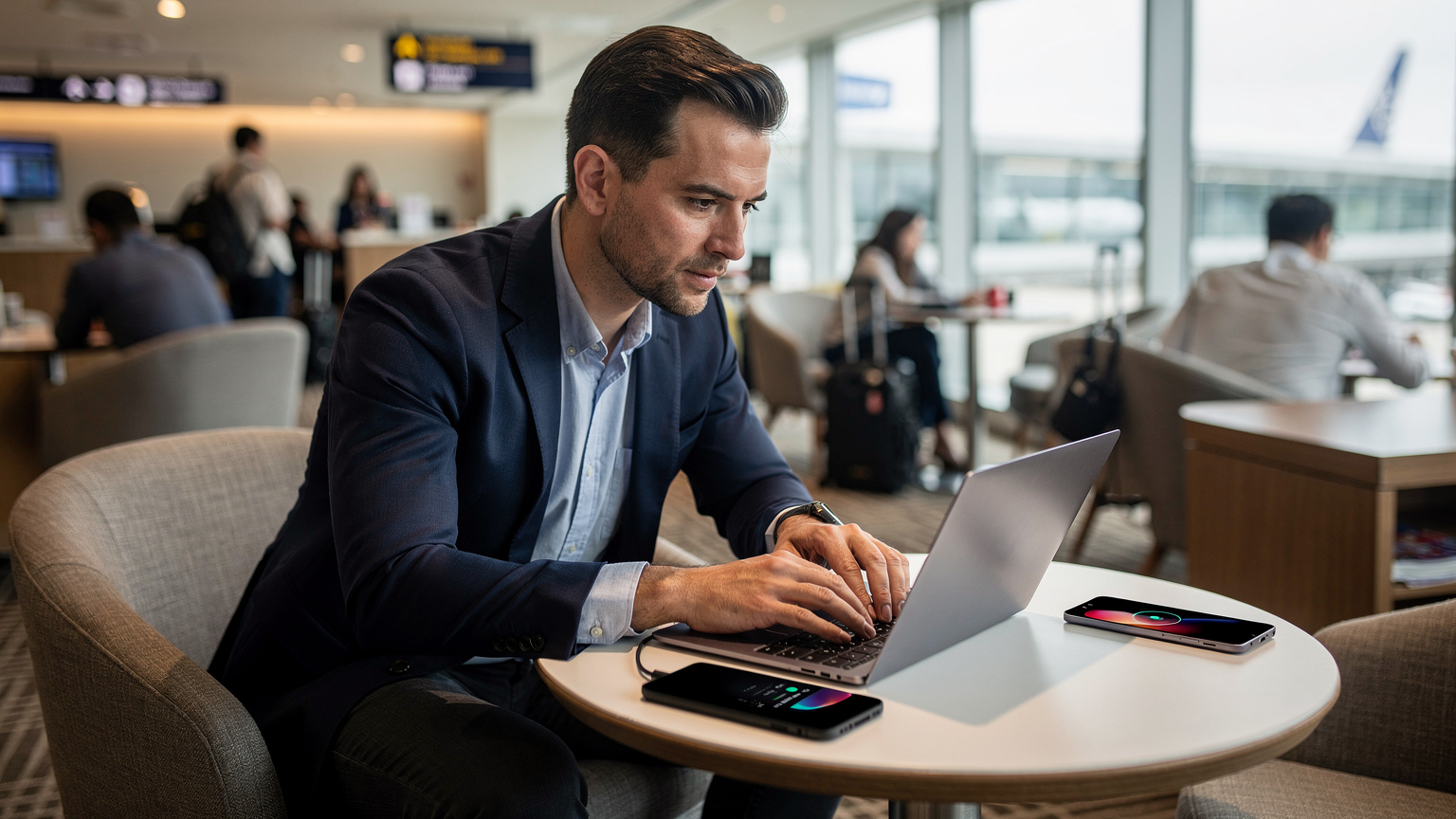
Why Unlimited eSIM is Non-Negotiable for Business Travel
Unlimited data isn't just a perk, it's a foundational requirement for modern business teams operating internationally. When you're managing a remote server farm from a café in Rome's Trastevere or collaborating on a live document with colleagues across time zones, every megabyte counts, and hitting a data cap mid-task is a nightmare scenario.
Uninterrupted Productivity on the Go
Think about a typical business day for a travelling professional. They might start with a video conference from their hotel in London's Canary Wharf, then spend the afternoon uploading large presentation files from a co-working space near the Eiffel Tower in Paris, and finally unwind by streaming a crucial industry webinar on the Thalys train back to Brussels. Each of these activities demands significant data. With an unlimited eSIM, the concern about exhausting a data allowance simply vanishes. This freedom allows teams to focus entirely on their work, rather than micromanaging their data usage.
I've seen firsthand the frustration when a team member, deep into a client pitch from the bustling streets of Bangkok's Sukhumvit, suddenly finds their data cut off. It disrupts flow, wastes valuable time, and can even jeopardize client relations. Unlimited data ensures that such interruptions become a thing of the past.
Seamless Collaboration Across Borders
Modern enterprises thrive on collaboration. Tools like Microsoft Teams, Slack, Zoom, and Google Workspace are integral to daily operations. For a distributed team, these platforms are the virtual meeting rooms, whiteboards, and water coolers. If a team member in Seoul needs to jump on an urgent video call with a counterpart in San Francisco, they need robust, high-speed data. Limited data plans often lead to pixelated video, dropped audio, and overall poor communication quality, hindering effective teamwork.
Unlimited eSIMs facilitate seamless real-time collaboration, whether it's for brainstorming sessions, critical decision-making, or simply staying connected with colleagues and clients. It's about creating a virtual office environment that feels as fluid and responsive as a physical one, regardless of geographical distance. This is especially true for those needing to capture every moment, such as visitors trying to share their experiences during Thai Songkran 2026, where constant uploading can quickly deplete limited plans.
Cost Efficiency and Budget Predictability
One of the most compelling arguments for unlimited eSIM for business teams is the profound impact on cost efficiency and budget predictability. Traditional roaming costs are notoriously unpredictable and often exorbitant. A single team member exceeding their data limit can blow an entire project's connectivity budget. This is a common pain point for finance departments trying to forecast travel expenses.
| Connectivity Option | Pros for Business | Cons for Business | Cost Predictability |
|---|---|---|---|
| Traditional Roaming | Immediate connection upon arrival (sometimes), uses existing number. | Extremely high costs, unpredictable bills, slow speeds after caps, complex expense tracking. | Low (very volatile) |
| Local Physical SIM | Potentially cheaper than roaming, local number. | Time-consuming to acquire, device limitations (single SIM slot), risk of losing SIM, managing multiple numbers. | Medium (fixed cost per SIM, but topping up can vary) |
| Hotel/Public WiFi | Free (often), convenient in some locations. | Inconsistent speeds, security risks, limited availability, reliance on fixed locations. | High (mostly free, but unreliable) |
| Unlimited eSIM | Predictable costs, high speeds, instant activation, multi-country coverage, enhanced security. | Requires eSIM-compatible device, initial setup for team (once). | High (fixed monthly/project cost) |
Unlimited eSIM plans, especially those designed for business, offer a fixed, transparent cost. This allows companies to budget precisely for their team's connectivity, eliminating bill shock and streamlining expense management. It's a fundamental shift from reactive cost control to proactive financial planning, freeing up resources that would otherwise be wasted on inflated roaming charges.
The Cost of Disconnection and the ROI of eSIM
Disconnection in a business context isn't just an inconvenience, it's a measurable drain on resources and productivity. Every moment a team member is offline, or struggling with poor connectivity, represents a tangible cost to the business.
Lost Productivity and Missed Opportunities
Consider a sales team in Tokyo's Ginza district, unable to access their CRM database due to a spotty connection, missing a crucial update on a client's purchasing intent. Or a field engineer in the remote areas of Iceland, trying to send diagnostic data from the Golden Circle, but unable to connect to the network. These aren't hypothetical scenarios, but real-world challenges that cost businesses dearly.
Lost productivity manifests in delayed project timelines, missed deadlines, and inefficient resource allocation. Missed opportunities can mean losing a competitive edge, failing to respond to market changes, or even jeopardizing client relationships. The cost of a few hours of downtime for a high-value employee can far exceed the monthly fee of an unlimited eSIM.
Expert TipData is the New Currency: In 2026, reliable internet access for your business teams isn't merely a convenience, it's a critical asset. Treat it as such, and invest in solutions that guarantee its presence, not its absence.
Quantifying the ROI of Unlimited eSIM
Calculating the Return on Investment for unlimited eSIMs is straightforward when you factor in the avoided costs and increased efficiency. Here's a simple breakdown:
- Eliminated Roaming Fees: This is the most direct saving. Compare your historical roaming expenditures for international travel against the flat rate of an unlimited eSIM plan. The difference is often substantial.
- Reduced Lost Work Hours: Estimate the average hourly wage of your travelling employees. Multiply this by the hours typically lost due to connectivity issues (e.g., searching for WiFi, troubleshooting, waiting for files to upload). An unlimited eSIM drastically cuts this downtime.
- Enhanced Collaboration Efficiency: While harder to quantify directly, faster communication, seamless file sharing, and reliable video calls contribute to quicker project completion and better decision-making, which indirectly boosts profitability.
- Improved Employee Morale: A less stressed, more productive employee is a happier employee. Removing connectivity worries improves job satisfaction, which can reduce turnover and increase overall team performance.
For instance, a team of five travelling to Europe for a month could easily accrue €500-€1000 in roaming charges per person. An unlimited eSIM for Europe's Smartest eSIMs might cost a fraction of that, offering immediate and significant savings.

Navigating the Global Network Landscape
The world's network infrastructure is a patchwork of different carriers, technologies, and regulations. What works perfectly in New York City's Midtown might be non-existent in a remote village in Laos. For business teams, this complexity can be a major headache.
Multi-Country Coverage and Carrier Partnerships
One of the key advantages of a premium eSIM provider for business teams is their extensive network of carrier partnerships. This isn't just about having *a* connection, but having the *best* connection in any given region. When I was working on a project in Southeast Asia, hopping between Laos and Cambodia, I remember how critical it was to switch effortlessly between different local providers like Lao Telecom and Cellcard depending on whether I was in Vientiane's city center or Siem Reap's outskirts.
A good eSIM service offers seamless transitions across multiple countries, often leveraging the strongest local networks available. This means your team doesn't have to worry about manually selecting networks or dealing with varying signal strengths. The eSIM intelligently connects them to the best available 4G or 5G service, ensuring consistent performance whether they're in the financial district of Dubai or the bustling streets of Rio.
Speed, Reliability, and Data Security
For business applications, speed and reliability are paramount. High-bandwidth activities like video calls, cloud computing, and large data transfers require robust 5G or high-speed 4G LTE connections. Unlimited eSIMs are designed to deliver exactly that, often prioritizing business traffic to ensure consistent performance.
Data security is another critical concern for enterprises. Public Wi-Fi networks, while convenient, are often breeding grounds for cyber threats. Business teams handling sensitive information cannot afford to compromise their data. eSIMs, by providing a secure, private connection through cellular networks, significantly reduce this risk. This is particularly important for compliance with data protection regulations like GDPR and CCPA, which are becoming increasingly stringent globally.
Case Studies: Where eSIM Saved the Day
It's one thing to talk about the theoretical benefits, but real-world scenarios truly highlight the impact of unlimited eSIMs for business teams.
The International Conference in Munich
I once consulted for a tech startup exhibiting at a major industry conference in Munich's Messe München. Their marketing team, comprised of five individuals, was responsible for live-streaming presentations, running interactive demos that required constant cloud access, and managing social media updates. In previous years, they'd relied on the conference's notoriously spotty Wi-Fi and individual data packages from local SIMs, which always led to frustration and unexpected costs, especially after 6 PM when the exhibition hall would empty out and connections would become even more congested.
For the 2026 event, they opted for an unlimited eSIM plan covering Germany. The results were night and day. Their live streams were flawless, their demos ran without a hitch, and they could upload high-resolution photos and videos in real-time to their social channels. One team member even used his phone's hotspot feature to power a second laptop for a last-minute presentation edit, all while riding the U-Bahn from their hotel in Schwabing to the conference center. The predictable cost allowed their finance department to breathe easy, and the marketing team achieved unprecedented engagement. You can read more about data savings for such events in the Oktoberfest 2026 guide, which shares similar principles.
A Remote Audit Team in Mexico City
Another striking example involved an audit team dispatched to Mexico City for a critical financial review. They were based in a client's office in Polanco, but also needed to conduct site visits in areas like Roma Norte and Condesa. Their work involved securely accessing sensitive company databases, conducting video interviews with local staff, and submitting daily reports, often requiring large file uploads.
Previously, they faced issues with local carrier contracts that required a Mexican tax ID (RFC) to get good rates, a bureaucratic hurdle for short-term visitors. With an unlimited eSIM, they bypassed this entirely. One auditor, a seasoned traveler, commented that it was the first time he hadn't had to spend an entire afternoon in a Telcel store trying to sort out a prepaid plan. Their connection was stable, even during peak hours, enabling secure and efficient data transfer. This level of reliability is critical for professionals who rely on essential 50GB+ eSIM for streamers & WFA pros 2026, let alone an entire audit team.
Deploying eSIM for Your Team: A Practical Guide
Implementing eSIM solutions for your business team might seem daunting at first glance, but the process is surprisingly streamlined. It’s a matter of choosing the right provider and integrating it into your existing travel policies.
Choosing the Right eSIM Provider for Enterprise
Not all eSIM providers are created equal, especially when it comes to enterprise-level needs. Here's what to look for:
- Extensive Global Coverage: Does the provider offer robust coverage in all the countries your team frequently visits? Look for multi-country or regional plans that simplify management.
- Unlimited Data Options: This is non-negotiable for business teams. Ensure true unlimited data without hidden throttles or fair usage policies that cripple productivity.
- Centralized Management Portal: For team deployments, a portal that allows IT or travel managers to activate, monitor, and manage multiple eSIMs from a single dashboard is crucial.
- Dedicated Business Support: When issues arise, you need rapid, knowledgeable support. Look for providers offering 24/7 business-specific customer service.
- Cost Transparency: Clear, predictable pricing models with no hidden fees are essential for budgeting.
For frequent travellers, a multi-carrier edge can make all the difference, as highlighted in Global Business Connectivity 2026.
Step-by-Step eSIM Deployment for Teams
Here's a simplified process for rolling out eSIMs across your organization:
- Identify Team Needs: Determine which team members travel internationally, their typical destinations, and their data consumption patterns. This will help you select the appropriate plans (e.g., global unlimited, regional unlimited).
- Choose an Enterprise eSIM Provider: Based on the criteria above, select a provider that aligns with your company's scale and travel requirements. Establish a business account.
- Order and Distribute eSIM Profiles: The provider will issue eSIM profiles (usually QR codes or manual activation codes) for each team member. These can be distributed via email or a secure internal portal.
- Team Member Activation: Each team member will activate their eSIM on their compatible device. This typically involves scanning a QR code or entering a short code in their phone's settings. It's a quick process, often taking less than two minutes.
- Integrate into Travel Policy: Update your company's travel policy to include guidelines for eSIM usage, expense reporting, and troubleshooting.
- Monitor and Optimize: Utilize the provider's management portal to monitor data usage, track costs, and make adjustments as needed for future deployments.
Integrating eSIM into Company Travel Policy
To ensure smooth adoption and compliance, integrate eSIMs seamlessly into your company's existing travel policy. Clearly outline:
- Approved Providers: Specify the preferred eSIM providers and plans.
- Reimbursement Guidelines: Detail how eSIM purchases or subscriptions will be expensed or paid for directly by the company.
- Usage Expectations: Set clear expectations for data usage, especially if personal use is permitted on company-provided plans.
- Support Channels: Provide clear instructions on who to contact within the company (e.g., IT, travel desk) and the eSIM provider for technical support or issues.
- Security Protocols: Remind employees of best practices for device and data security while travelling, especially when using company-issued eSIMs.
By defining these parameters, you empower your team with reliable connectivity while maintaining corporate oversight and budgetary control. For general questions about how eSIMs work, you can always check our FAQ section.

Security and Compliance with eSIM in Enterprise
For any enterprise, security and data privacy are paramount, especially when employees are travelling and accessing sensitive company information. eSIM technology offers significant advantages here over traditional methods.
Enhanced Security Features of eSIM
Unlike physical SIM cards, eSIMs are embedded directly into the device hardware. This makes them far less susceptible to physical tampering or theft. There's no physical card to lose, and the digital profile is more secure against cloning attempts. Furthermore, eSIM profiles can often be managed remotely, meaning that in the event of a device being lost or stolen, the eSIM profile can be deactivated instantly, cutting off data access and mitigating potential security breaches.
Moreover, using a dedicated eSIM for cellular data avoids the inherent security risks associated with public Wi-Fi networks. As anyone who has tried to send a confidential email from a crowded coffee shop in Paris's Le Marais district knows, open networks are a security minefield. eSIMs provide a private, encrypted connection, protecting sensitive business communications and data transfers.
Meeting Data Privacy Regulations Globally
With an increasing patchwork of global data privacy regulations, from GDPR in Europe to various data localization laws in APAC, businesses must be vigilant. eSIM providers often have robust infrastructure and partnerships that help ensure compliance. By using recognized, secure cellular networks, businesses can reduce the risk of non-compliance issues related to data in transit. This is a crucial consideration for teams involved in cross-border data management, legal due diligence, or sensitive client interactions.
Looking Ahead: eSIM Innovations for 2026 and Beyond
The eSIM landscape is evolving rapidly, with new innovations constantly emerging to make global connectivity even more seamless and powerful for enterprise users.
5G and Low-Latency Connectivity
As 5G networks continue their global rollout, eSIMs are at the forefront of delivering these next-generation speeds to business users. For tasks requiring ultra-low latency, such as remote surgery simulations, real-time analytics from IoT devices in the field, or complex financial trading, 5G-enabled eSIMs will be indispensable. Imagine an engineering team in Shenzhen collaborating on a virtual reality prototype with colleagues in Silicon Valley, requiring instantaneous data transfer. 5G via eSIM makes this a reality, pushing the boundaries of what's possible for global teams.
| Technology | Typical Latency | Business Use Case | Impact on Productivity |
|---|---|---|---|
| 4G LTE | 50-100 ms | Video conferencing, email, cloud storage, web browsing. | Good for general tasks, occasional delays on high-bandwidth apps. |
| 5G (Sub-6 GHz) | 10-20 ms | High-definition video streaming, large file transfers, real-time collaboration tools, remote device control. | Significantly enhanced, smoother operations, faster data sync. |
| 5G (mmWave) | ~1 ms | Augmented Reality (AR) applications, virtual reality (VR) collaboration, autonomous vehicle control, remote precision machinery. | Revolutionary for highly specialized, latency-sensitive applications. |
eSIM Management Platforms and IoT Integration
The future will see even more sophisticated eSIM management platforms, offering deeper integration with enterprise IT systems. This means automated provisioning of eSIMs based on travel schedules, granular control over data policies, and real-time analytics on usage and costs.
Furthermore, the integration of eSIMs with the Internet of Things (IoT) will open up new possibilities for businesses. Imagine a global logistics company tracking its fleet of vehicles and cargo across continents, with each asset equipped with an eSIM for seamless, secure data transmission. Or smart sensors deployed in remote industrial sites, reporting data back to a central hub via eSIM connectivity. The potential for efficiency gains and operational visibility is immense, transforming how enterprises manage their global assets and operations.
The landscape of enterprise travel is undergoing a profound transformation. In 2026, the competitive edge belongs to those businesses that empower their teams with seamless, secure, and unlimited global connectivity. eSIM technology isn't just a convenience, it's a strategic imperative that fuels productivity, optimizes costs, and secures the future of global projects.
Frequently Asked Questions
Why is unlimited data so important for business teams?
Unlimited data ensures uninterrupted productivity for critical tasks like video conferencing, large file transfers, and cloud-based collaboration. It eliminates the worry of hitting data caps mid-project, preventing delays and maintaining consistent workflow across global teams.
How do eSIMs reduce costs for enterprise travel?
eSIMs significantly reduce costs by eliminating exorbitant traditional roaming fees. Instead, businesses can opt for predictable, fixed-cost unlimited plans, leading to substantial savings and better budget forecasting compared to variable roaming charges.
Are eSIMs secure enough for sensitive business data?
Yes, eSIMs offer enhanced security. They are embedded digitally, making them less prone to physical theft or tampering than traditional SIM cards. Additionally, using a dedicated cellular connection through an eSIM is generally more secure than relying on potentially compromised public Wi-Fi networks for sensitive business communications.
Can multiple team members use the same eSIM plan?
While individual eSIMs are typically assigned per device, many enterprise eSIM providers offer centralized management platforms. These platforms allow IT or travel managers to easily provision and manage multiple eSIM profiles for an entire team under a single business account, often with shared data pools or individual unlimited plans.
What devices are compatible with eSIM technology for business use?
Most modern smartphones, tablets, and even some laptops released in the last few years are eSIM compatible. This includes popular models from Apple (iPhone XS and newer), Samsung, Google Pixel, and Microsoft Surface. Always check specific device specifications for eSIM support.
How quickly can a team member activate an eSIM abroad?
One of the major benefits of eSIM is rapid activation. Once an eSIM profile (usually a QR code) is provided, a team member can activate it on their compatible device in a matter of minutes, without needing to find a local store or physically swap SIM cards. It's often done before even leaving the airport.